Asset prioritisation (climate risk) at Victorian Department of Transport and Planning

Overview
The Victorian Secretaries Board (VSB) mandated in May 2024 that government departments conduct comprehensive climate risk assessments to enhance adaptation maturity, with progress reports due in April 2025. To fulfill this requirement, the Victorian Department of Transport and Planning's (DTP) Accommodation & Workplace Services (AWS) branch partnered with Sustain 2050 to evaluate physical climate risks across 43 fixed assets. Our analysis provided actionable insights into prioritising assets amid limited adaptation budgets, forming a cornerstone of DTP's submission to the VSB.
The Challenge
DTP needed to address key questions in a resource-constrained environment:
Quantification: Projecting expected damage costs over time under various climate scenarios.
Prioritisation: Identifying assets most vulnerable to climate change.
Visualisation: Analysing the return on investment (ROI) and payback periods for adaptation and resilience measures.
Considerations included balancing climate risk with asset criticality, developing a robust decision-making framework, creating flexible visualisations, and using secure, pre-approved tools like Microsoft Power BI.
Our Approach
Sustain 2050 delivered a multifaceted solution leveraging advanced climate science, AI, and high-performance computing:
Geospatial Enablement: Mapped assets for location-based insights.
Climate Risk Intelligence: Modeled physical perils including riverine flooding, precipitation risk, extreme wind, heat stress, coastal inundation, drought, and bushfire.
Damage Function: Quantified Climate Value-at-Risk (VaR), estimating expected financial losses over time.
Prioritisation & Business Case: Developed asset prioritisation tools and cost-benefit analyses for resilience investments.
Visualisation: Built an interactive Climate Risk Dashboard in Power BI for portfolio overviews, asset rankings, and detailed single-asset hazard views.
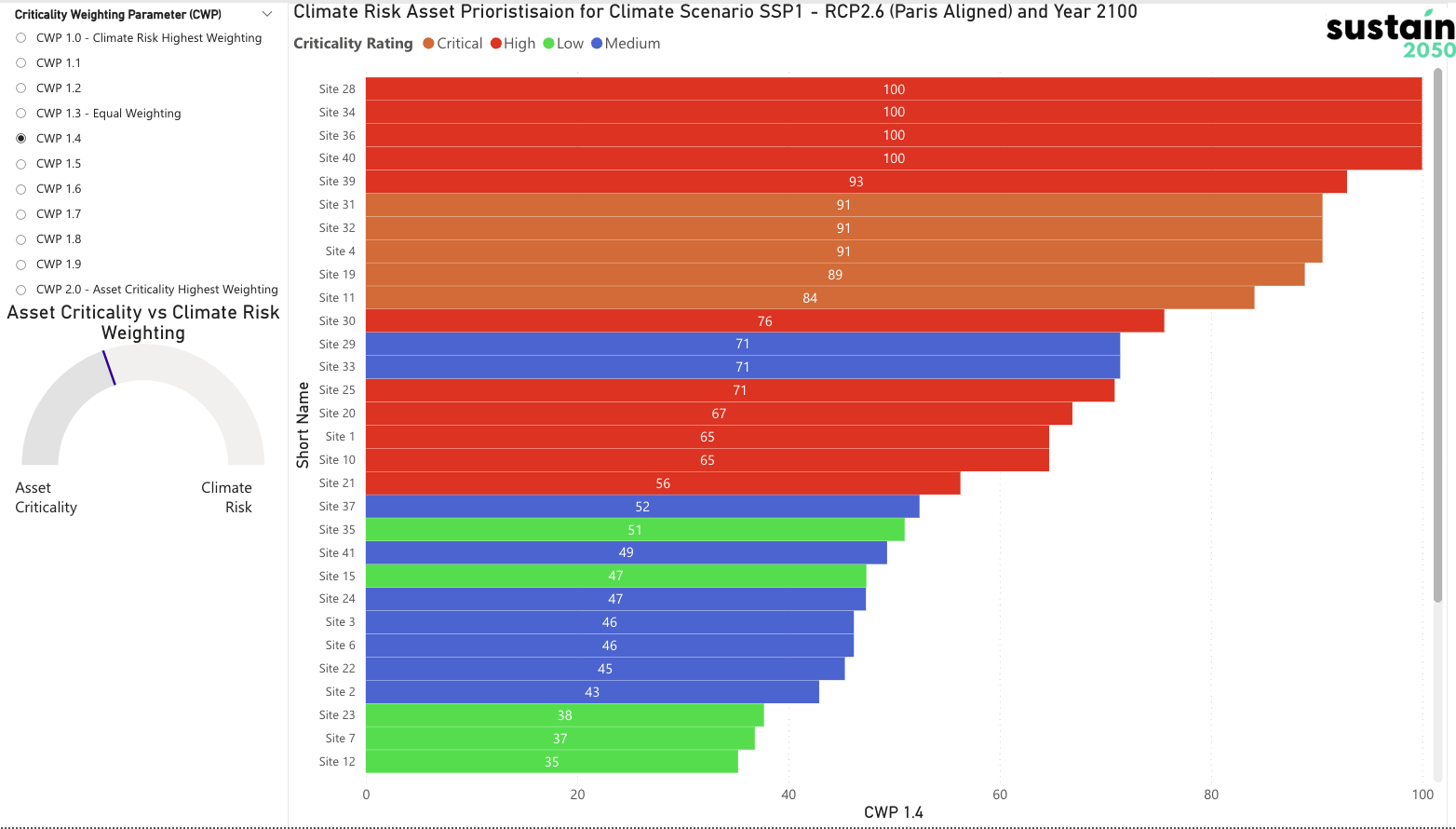
Asset prioritisation tools and cost-benefit analyses for resilience investments.
We analysed risks across three scenarios (Paris Aligned at 1.5°C, Emissions Peak in 2040 at 2.5°C, and Business as Usual at 4.0°C) from 1970 to 2100. Risk metrics included a 0-100 climate risk score per asset-scenario-timeline combination and expected annual losses from 1-in-100-year events for perils like extreme wind and flooding (expressed as a percentage of asset valuation).
A key innovation was our tunable model, which balanced tradeoffs between an asset's climate risk and its business criticality. This provided DTP with an auditable, transparent method to justify prioritisation decisions, ensuring defensibility in reporting.
Outcomes and Insights
Deliverables: A comprehensive written report aligned with the Department of Climate Change, Energy, the Environment and Water (DCCEEW) Climate Risk and Opportunity Management Program (CROMP) format, plus a secure, user-friendly Power BI dashboard.
Strategic Discovery: Our analysis uncovered a critical asset slated for a $50 million upgrade that faced extreme coastal inundation risk by 2060. This insight prompted the state to redirect investments to a lower-risk location, avoiding significant financial waste and enhancing long-term resilience.
This proof-of-concept project empowered DTP to make data-driven decisions, optimising limited budgets for maximum impact. By integrating climate intelligence with business priorities, Sustain 2050 helped DTP advance its adaptation strategy while meeting government obligations.